segunda-feira, 10 de agosto de 2009

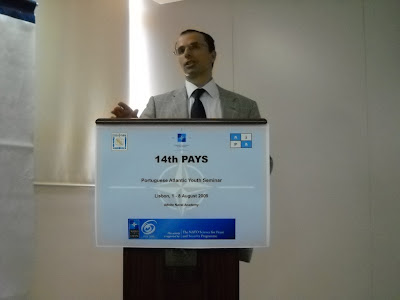
PAYS Day 7 - Presentation of NSC Drafts and Seminar Reports by the participants

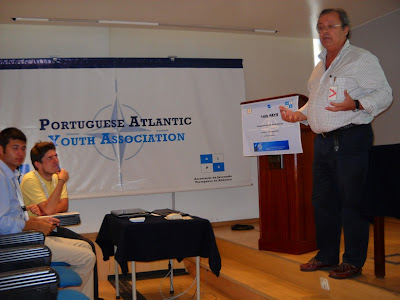
The seminar was concluded with the presentation of the New Strategic Concepts drafted by the participants and their reports on this week. The documents will be available soon in the blog and our site.


PAYS Day 7 - "The Lisbon Summit, the Lisbon Young Atlanticist Summit and the New Strategic Concept"


On the 7th of August 2009 took place the last day of the 14th Portuguese Youth Atlantic Treaty Association. This final day resulted in the most important day of debate, since the participants had the chance to listen the NATO Assistant Secretary General for Public Diplomacy, Mr. Jean François Bureau, who gave an interesting lecture about the challenges NATO is facing and how is it being planned to cope with these new problematic. The panel of speakers was also composed by H.E. Ambassador Manuel Tomás Fernandes Pereira, Portuguese Permanent Representative at NATO and by Professor Carlos Gaspar, Director of the Portuguese International Relations Institute.

Both speakers tried to focus on different perspectives allowing a better comprehension about the topic in discussion: The Lisbon Summit, the Lisbon Young Atlanticist Summit and the New Strategic Concept. This conference must be seen as extremely important, once it was the first step, the first debate in the long run to the definition of the New Strategic Concept. As the speakers agreed, “The eyes of the World are in Lisbon today, and this Seminar is fundamental for the brainstorming and debate”. 

Accordingly with the topic in debate, Mr. Jean François Bureau raised some key questions, from the most importance to the future of NATO: How is it possible to manage the difference between Defence and Security (regarding the article 5 commitments); the new emerging threats, such as Energy, Terrorism, Ciberterrorism, augment of Arms of Massive Destruction; the relationship between NATO countries and the world. 

As such, Mr. Jean François Bureau believes that the discussion of this New Strategic Concept must be as wide as possible. NATO is trying to involve people, showing that everyone will be heard and their thoughts will be taken into account in the decision making. As so, Mr. Bureau presented an Organization with new objectives, open to the public debate, enrolled in the “battle of the new technologies”, searching for comprehension and legitimacy to ensure the evolving process of NATO.

Following this remarks, the Portuguese Ambassador stated that the future of the Organization and the future of the world was being discussed in this conference, by participants from different nationalities, whose different points of view are extremely important to better adapt NATO to the new challenges above mentioned. The Portuguese Ambassador focused on more practical speech, reinforcing the importance of a clearer and open debate. As so, the Lisbon Summit is going to be a huge event, with a large participation. Portugal is really important in all this process, because of its old History, which allows it to play an important role in creating and stimulating the proximity and the debate, not only between NATO member countries but also non-member countries and international organizations.


As so, the main topics in the Lisbon Summit of 2010 are going to be: Security and Defence; the acceptance of the roadmap designed by the 12 international experts (in this roadmap the public opinion will have the chance to attend several other events, debates, conferences, seminars, where the discussion will take place, contributing to the wider debate that is suppose to achieve); the importance of the definition of a shorter strategic concept, different from the one in 1999, with 65 paragraphs. To sum up stated that “people that are interested in this issue will give good ideas to be reflected by the decision makers”. 

Professor Carlos Gaspar gave a more academic speech, referring some polemic issues around this topic. The first note regarded the fact that since 1991 this is going to be the 3rd Strategic Concept. Secondly, stated that for the first time, the public debate is at NATO’s concerns. Bearing this in mind, the Professor reminded a paradox, emerging from the fact NATO needs to change but, at the same time, some people believe that NATO is a well succeeded organization, the one that won the Cold War. As such, it is quite complicate to combine both. Consequently, the debate around the New Strategic Concept is going to take place in a period of deep divisions, mainly related with the “nature of NATO”, as regional defence alliance or a global defence alliance; relation between NATO and other international actors, such as European Union and the role of the United States of America inside the Organization. 

Regarding the division between regional and global, affirmed that the first one can kill NATO due to its lack of ambition; the second one can kill NATO due to its excess of ambition. As so, a third way is emerging, related with deterrence, aiming to conciliate not only the interests of the member countries but also of the other international actors.

To sum up, it can be said that the main objective of the New Strategic Concept circulates around the need of legitimacy and recognition by the international public opinion, in order to better understand the role NATO in the world as a stabiliser, fundamental to the security of nations and their citizens. 

Jorge Piteira Martins

PAYS Day 6 - Policy-making simulation


In the 6th day the participants were divided in groups and worked on drafting the New Strategic Concept as well as on the Seminar Reports to be presented in the next day. The Drafts and the Report will soon be available online.


PAYS Day 5 - Visit to NATO Joint Command Lisbon

The fifth day of the 14th PAYS started with the traditional visit to NATO Joint Command Lisbon. After being welcomed by General Pinheiro, Deputy Commander of JCL, the participants were briefed on NATO's organization by Lieutenant Colonel Ciprian Radulescu. That intervention was followed by a more operational briefing by Lieutenant Colonel Chris Scully, who gave the participants an important and interesting insight in what concerns the anti-piracy operations that NATO is running in the Gulf of Aden.


domingo, 9 de agosto de 2009

PAYS Day 4 - "Insecurity in Africa"

Following the lectures about International Security and Security System Reform, the afternoon of the 4th day of PAYS, was about Insecurity in Africa.


The lecturer, Professor Pedro Borges Graça, started the conference by asking the public their thoughts about Africa. This raised the general interest and gave a very interesting dynamic to the discussion. Later on, after hearing all the different opinions, Mr. Borges Graça, summed them up and gave them a hint of his own analysis.

Evaluating the continent the lecturer reminded the public about the very different dimensions one finds there. Firstly he identified 3 critical points for security in Africa. The first is in the Horn of Africa, another one being the Guinea Golf and South Africa. This analysis was based on a basic division between North Africa and sub-Saharan Africa, where he identified a basic difference in state consolidation and the notion of nation state. On one hand there was only one nation state in Sub-Saharan Africa to begin with, Botswana, whereas in the Muslim Arab countries most states had a national basis one way or the other. Therefore there were very few security risks involved. The real threat there lay in those shatterbelt states, situated right in the middle, those between one and another Africa, states such as Nigeria, Mali and others.


This continent has indeed two major structural damages. As we have said, there is the problem of nation vs state. African borders are not in accordance with the different ethnic identities which would be too many and too small in numbers to constitute viable states anyway. Thus, the consolidation of the state structures is a starting challenge still to be met in many countries.

This gave way to the second structural liability of these regions: a vicious cycle revolving around a series of other problems: social, economic and political. Where one cannot be solved without the other, and where one causes another. In a very simple way, Professor Borges Graça explained the reason for the never ending drama that Africa has been for the last forty years.
Before the session ended the lecturer tackled the present and future of the continent, this turn as a competition site for foreign powers in Africa. The argument appointed American difficulties and the European lack of resources, to establish the needed influence in the continent. Stating that the US have the means and some European countries (namely Belgium, France, Portugal and the U.K.) have the know how since they are more familiarized with the continent. That would be why the American government has been having problems negotiating an African location for the establishment of their military command, AFRICOM.

Jorge Wahnon

PAYS Day 4 - "International Security and NATO" and "NATO's role in Security System Reform"

The fourth day of the 14th Portuguese Atlantic Youth Seminar began with the morning presentations of Inês Narciso, from the Portuguese Atlantic Youth Association (PAYA), and Mónica Ferro, from the School of Social and Political Sciences.


Focusing on the topic “International Security and NATO”, Ms. Narciso made an interesting analysis, which was accompanied by a series of key questions related to the discussion around the new Strategic Concept of the organisation. 

The lecturer found that the post Cold War period meant several changes for NATO, globalisation, pandemics and terrorism being some examples. Considering that soon the security paradigm started to evolve, as international organisations and the individual join the State as providers, and that the international society faces “New Wars”, as today’s conflicts occur more and more on an internal level, there’s a necessity to update the concept of Collective Defence and of “armed attack”.


Several challenges arise, externally, the shift of power and the multipolarity of the international system, proliferation and energy issues, internally, the question of burden sharing, the importance of geography in threat assessment and the relations with Russia.
NATO’s scope was object of analysis too, questioning its either global or regional focus, as there’s a tendency to out of area operations, which will pose the question of future enlargements and of the ongoing close relation with the UN.


The second presentation, of Mónica Ferro of the School of Social and Political Sciences, focused “NATO’s role in the Security System Reform”. Since the late nineties the approach as slowly changed as the reform is to be put forward on an internal level by each State, with different objectives, as of assuring human security or development. This reform will naturally include cooperation with organisations such as NATO or the E.U.

Carina Machado

PAYS Day 3 - "The importance of the Atlantic South" and "NATO's military capabilites transformation"

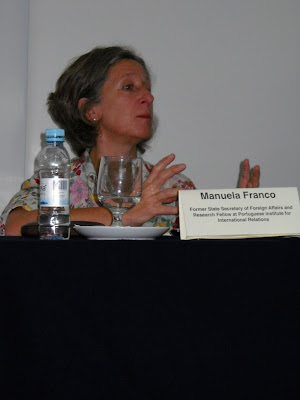
In the third day of the Portuguese Atlantic Youth Seminar, Manuela Franco, former State Secretary of Foreign Affairs and research fellow at Portuguese Institute for International Relations, exposed her broad views on the new international order and the inevitability to reform the strategic concept. The speaker reinforced the importance of the Pacific area and the new emerging great powers; some of them with authoritarian regimes seeking for regional hegemony, also defending that NATO should open its door to new partnerships in latest geostrategic regions like Atlantic South, where after the end of Apartheid in South Africa and the democratization in South America, BRIC’s concept has been risen.


Thus, a whole new meaning for this region turned out to be relevant. This is not only because of the strategic resources but also due to its illegal activities spread potential, considering the lecturer that NATO and particularly the US will here concentrate its concerns for the next years. The Caspian Sea could potentially be another point of tension and competition between some of the great powers.

Manuela Franco also pointed out the civilization of security that threatens the basic principles of democracy, believing that the Atlantic Alliance lives an anachronism, which can only be improved on the basis of the full perception of the external challenges, political participation and international law expansion. For Mrs. Franco, NATO will be more necessary in the future than it has been in the last few years. Therefore, there is the obligation to deal with problems besides war that cannot be ignored, if we take into account that political issues lift bigger problems than economic ones. Border tensions, the possible misunderstanding between national interests and economic benefits, as also the confusion involving military force, police force and humanitarian action, were highlighted as well.


In the second half of this conference, Lieutenant Colonel Francisco Proença Garcia of the Portuguese Delegation at NATO, spoke about NATO’s military capabilities transformation. In this matter, the visiting lecturer underpinned the returning to a pre- Westphalia past, where actors as militias and guerrillas are gaining more and more control over the monopoly of violence, outside the dominion of states, bringing several political tribulations.


Regarding this, we live in an epoch where the distinction between civil and military is disappearing, besides the demilitarization of war, exploring resources and fighting against people. This question is even more evident in the so called failed states.

For the speaker, military transformation is a result of knowledge society that has propitiated new weapons, which are smaller, longer range, furtiveness and robotized. Currently, the main goal of this kind of operations is demobilize instead of destruct. The importance of information is vital for the military capabilities transformation, being a strategic resource which allows faster responses in a multilateral environment. A new concept of operation was also mentioned, with characteristics of integration, flexibility, modularity and initiative. This kind of action needs less human forces and is conducted by a remote control.

Daniela Rodrigues

PAYS Day 2 - "Outcome of Strasbourg/Kehl Summit" and "Communicating Atlantic Values in the 21st century"

The “Outcome of Strasbourg/Kehl NATO Summit” and “Communicating Atlantic Values in the 21st century” were the two lectures that followed lunch in the afternoon of the second day on the 14th PAYS.


Beginning the conference, Samuel de Paiva Pires, president of the Portuguese Atlantic Youth Association, pass forward to the participants his conclusions about the Strasbourg/Kehl NATO Summit. Having been present in the Summit that occurred in April, Samuel started by giving the audience a historic background on NATO, why it was created, the deterrence during the cold war ant its reconfiguration after the fall of the Berlin Wall, mentioning the mutation suffered by NATO during the 90s and its adaptations to the global challenges that pass beyond peace and stability, ranging from the nuclear proliferation, terrorism, enlargement and the new partnerships. Those were the challenges that led to the Summit and to the acceptance of the draft of the new strategic concept. Taking advantage of its political capital, Barack Obama, not only endorse the adjustment of NATO’s strategic concept, but also asked the Europeans for a larger support in Afghanistan and brought the need for “sharing burdens”, not only military, but human, political and financial. Other highlights of the Summit were: the French reconciliation within NATO and it’s reintegration in the military structure; the official membership of Albania and Croatia; the presentation of priorities to Afghanistan and the need to reestablish relations with Russia.


With the next lecturer, Giuseppe Belardetti, president of the Youth Atlantic Treaty Association (YATA), the participants got presentation/formation on how to communicate Atlantic values in today’s world. Speaking from his personal experience, Giuseppe believes that despite the efforts made by NATO, the organization still can’t get trough its message to the average citizen, being its mission and goals damaged by the lack of an understandable approach to the public. Due to that, it’s easier to dissociate the values from the institution, passing forward the common history, ideology and politics between USA, Canada and Europe. Focusing specially on young people, Bellardetti talked about the need to inform teenagers, college students and young professional about what is NATO, and told the audience how to make it efficient and appealing. In what regards YATA, he defends the importance of its national or regional role in getting people involved, spreading the importance of the organization and its goals. The YATA associations can, in some circumstances, be more effective spreading information to the public and especially reaching young people (a difficult target for NATO public diplomacy). The media role and the importance of positive information were also topics on his presentation.


The lectures were followed by an intense debate with contributions from many participants of different nationalities.

Catarina Falcão

PAYS Day 2 - "Insight to Portuguese culture"

The second day of the 14th edition of the Portuguese Atlantic Youth Seminar opened with a contextualization of the Portuguese culture, history and current foreign policy core objectives and current situation. Professor Victor Marques dos Santos (PhD, School of Social and Political Sciences) was this lecture’s speaker.

Assuming that Portugal is 866 years old (signature of the Treaty of Zamora), the country soon found three main geostrategic principles: geographical proximity to North Africa and consequently to Islam; geographical proximity to the Kingdom of Léon and Castilla; and the art of mastering the sea, led by a lack of opportunity to expand North, South and East. This curious external factor “turned compasses” West and gave “New Worlds to the World”. So, the process of colonization and the establishment of an Empire brought social and political integration.

However, the meaning of “Power” has changed through ages. On the 20th century, International organizations such as NATO, United Nations, the European Union, Council of Europe, or the Organization for Security and Cooperation in Europe, and Globalization, stereotyped the West as a secure, democratic region, with stable governments and with ethic and moral values, where freedom prevails. Therefore, the West distinguishes itself from “the rest”.

Nevertheless, “everything is at stake”, once the major objectives and the own State sovereignty were moved to Brussels. The National Interests are modeled according to each organization in order to standardize the goals, so that it won’t interfere with the basic principles.

In this chapter, Portugal is analyzed in the international frame. Portugal’s non-isolation policy is strengthened by the participations in such organizations. So, the internationalization of Portugal’s politics and economics is prepared by an active diplomacy, throughout bilateral and multilateral relations. Nonetheless, Portuguese participation in the international scenario lacks the responsibility to protect, although the country uses as its instruments of foreign policy, diplomacy, negotiation, participation in decision-making and participation in out-of-area missions.

José Miguel Pires

domingo, 2 de agosto de 2009

PAYS kicks off

The 14th Portuguese Atlantic Youth Seminar, taking place in the Alfeite Naval Academy, started Saturday (1st of August), with more than thirty participants. The seminar presentation panel counted with Rear Admiral Luís Macieira Fragoso, Alfeite Naval Academy Commander, Mr. Bernardino Gomes, Executive President of the Portuguese Atlantic Treaty Association, Giuseppe Belardetti, President of the Youth Atlantic Treaty Association and Samuel de Paiva Pires, President of the Portuguese Atlantic Youth Association, as introductory speakers and with Professor António Vitorino as its keynote speaker. Professor Vitorino, former European Commissioner for Justice and Home Affairs, is spoken of as a possible nominee for NATO’s wise-men group.

The keynote speech was, as is this seminar, focused on the Alliance’s new strategic concept that is scheduled to be discussed and adopted in Lisbon, during the next year. Professor Vitorino explained that it has always been the basic political guideline of the Organization and its members. It proved to be vital for the adaptation and evolution of NATO troughout it’s sixty years of existence. However unlike the time when the “Iron Curtain” fell, 9/11 proved to be a bigger challenge for NATO. In the Professor’s wording the Alliance hasn’t yet adapted as well to this new paradigm of the XXI century, where it is facing threats from both conventional and unconventional forces, where the line distinguishing defence and national security has faded.


Despite the apparent difficulties to adopt a new strategic concept, Mr. Vitorino believes that now is a better time than ever to give the Alliance the conditions it needs to adapt to a post-9/11 world. He stated that the change of the US’s views on an EU Defence Community since Istanbul, the French reintegration in the military command structure, and the personal charisma of Barack Obama are some of many contributing factors that demise a previously sore relationship, opening room for the strengthening of links.

The spokesperson introduced 4 main issues with which NATO is faced with and that should guide us throughout the upcoming week. First is the evaluation of the re-implementation of the collective defence policy adapted to today’s and tomorrow’s world. Then, he referred the urgent need for the redefinition of what are considered to be the alliance’s main threats. Thirdly, a question about whether NATO should remain mainly a political and military organisation or if it should broaden its nature and include other structures, with different specialties. Finally, he deemed it necessary to mention the way the European public opinion understands the Alliance and the need for that to be changed.

As the lecture finished, many questions were raised and a lot of discussion followed, fulfilling the objective of this first concept: to introduce debate over the new strategic concept among participants.

sexta-feira, 31 de julho de 2009

14.º Seminário da Associação da Juventude Portuguesa do Atlântico - Press Release


14.º Seminário da Associação da
Juventude Portuguesa do Atlântico

1-8 Agosto - Escola Naval - Alfeite

Press release - 31-07-2009
A Comissão Portuguesa do Atlântico e a Associação da Juventude Portuguesa do Atlântico organizam pelo 14.º ano consecutivo o Seminário Internacional da Juventude, este ano subordinado ao tema do Novo Conceito Estratégico da Organização do Tratado do Atlântico Norte (OTAN), contando para isso com 50 participantes representativos de 16 nacionalidades de Estados Membros e Parceiros para a Paz desta organização. O seminário decorre de 1 a 8 de Agosto na Escola Naval do Alfeite. 
A sessão inaugural, que terá lugar na Escola Naval, às 17.45 do dia 1 de Agosto, contará com a presença do Dr. António Vitorino como key-note speaker, estando a imprensa convidada a assistir. 
Agradece-se confirmação com a finalidade de se tratar da credenciação para aceder às instalações da Escola Naval (através do email samuelppires@gmail.com ou por telefone para Sofia Moniz Galvão – 915816611).
(o programa do Seminário encontra-se disponível aqui)

terça-feira, 28 de julho de 2009

Portuguese Atlantic Youth Association News Clipping Nr. 3

(Boing C-17 Globemaster III at PAPA Airbase)


Dear and Esteemed Friends and Colleagues,
The third news clipping is as follows:

Summary

Title: Russia Proposes Anti-piracy cooperation with NATO
Source: English People's Daily Online

NATO and Russia have suspended their military-to-military cooperation after Russia-Georgia’s war, but the recent events of piracy in the seas of Africa are changing this issue. Dimitry Rogozin, Russian ambassador to NATO, has proposed military cooperation with NATO to control piracy. Rogozin said that one of Russia’s plans is the creation of an international court to decide on those matters.

Title: Russia Warns Against Arms Sales to Georgia
Source: The New York Times

Georgia is expecting a weapon supply from the USA, but President Medvedev has recently announced that Russia will impose sanctions to those who dare to sell weapons to Georgia. President Medvedev has said that it’s more dangerous rearming Georgian people than Georgia’s entrance to NATO. After Russia-Georgia’s war, U.S.A. only supports Georgia’s army with training and organization. Despite these new events President Medvedev has said that Russia needs good and friendly relations with USA.


Title: EU's Solana in Afghanistan visits
Source: BBC News

The presidential election in Afghanistan is near and in order to assure the good electoral process, Javier Solana, the European Union foreign policy chief, will travel to Afghanistan. The EU will send an election observer mission for the presidential and provincial council elections. Mr. Solana will meet the Afghanistan foreign minister and the head of the EU mission in order to emphasize the EU support in Afghanistan.

Title: Biden in Ukraine to assure leaders of U.S. backing
Source: Reuters

The American vice-president Joe Biden arrived in Ukraine aiming to establish diplomatic talks and to assure the American presence in Eastern Europe. Biden has found internal problems in the country, due to manifestations against the government. The Ukrainian President Viktor Yushchenko wants to guarantee the American support in case of a Russian threat. The vice-president Joe Biden has declared that Ukraine needs some changes, mainly in energetic policies so that the country can reduce the energetic dependence on Russia.


Title: Obama’s Inheritance: Al-Qaeda in Retreat
Source: World Affairs Journal

One of President Obama’s speeches had some critics to George W. Bush’s national security policies, but president Obama might be wrong. George. W. Bush left USA presidency with a feeling of safety guaranteed by its 2688 days passed without a terrorist attack on its soil.
Analyzing the inheritance of George W. Bush, we can see that when Mr. Bush went to the White House, there were too many terrorist problems in Pakistan, Afghanistan and Iraq. Then, in 7 years, the great efforts of the Bush administration have made important changes in the leadership of those states and nowadays America can easily avoid the terrorism. Now it’s time to President Obama keep the safety left by George W. Bush.


Tiago Alfarroba
Portuguese Atlantic Youth Association

quarta-feira, 22 de julho de 2009

Portuguese Atlantic Youth Association News Clipping Nr. 2

(NATO Joint Command Lisbon)


Dear and Esteemed Friends and Colleagues,
The second PAYA news clipping is as follows:

Summary

Title: A Shared Security Strategy for a Euro-Atlantic Partnership of Equals
Source: Center For Strategic And International Studies

It's imperative, now that we are discussing the new strategic concept, that Europe and USA pursue the development of a shared Euro-Atlantic strategy. Combining the efforts, both USA and European Union, should create a new strategy that will combine soft and hard power to produce good answers for tomorrow’s problems. You can download a paper that explains the needs and the capabilities of this alliance. This paper shows why we should cooperate and what both USA and EU need to do to take benefits of the partnership, and why should we do it as fast as we can.

Title: World financial crisis: what it means for security
Source: NATO

Today we are facing a financial crisis that is changing the world. We fear that this financial crisis can be the heart of a more extended crisis since we can easily see the effects of the great depression in today’s crisis, the hardship and the formation of some political extremism.
In this edition of NATO Review, we will analyze this crisis, the need to choose between reduce the defense budget or keep it as it was, we will examine China’s economic growth and its subsequent political one, protectionism as one “twist of the knife” concerning the economical and political aspects, and the need of a bigger investment in the development of renewable energies.

Title: General Stoltz -- First French general to lead Joint Command Lisbon
Source: Allied Joint Command Lisbon

General Phillipe Stoltz is the first French to command a NATO headquarter since the announcement of the French return to NATO's military command structure. The general will be in charge of the NATO’s military base in Oeiras, Lisbon. The Joint Command Lisbon is the headquarter responsible for commanding NATO’s counter piracy operation in the African seas.

Title: The Future of the Atlantic Alliance
Source: NATO

NATO Secretary General Jaap de Hoop Scheffer made a speech in London explaining the Future of the Alliance. The speech started with a presentation of what he has done the position of America and Europe, the increasing number of members like Albania and Croatia, and the increase of NATO’s operations. Secretary General Jaap de Hoop has also made a list of important issues which NATO should take care of, in order to assure that the Alliance keeps going in a good track, such as political dialogue, a comprehensive approach to nowadays’ security challenges, the development of better troops, the improvement of the NATO-Russia relationship and the persistent development a global partnership. Jaap de Hoop finished his speech emphasizing the importance of the new Strategic Concept.


Title: Members of the NATO PA Science and Technology Committee visited the United States last week
Source: NATO Parliamentary Assembly

Seventeen members of the Science and Technology Committee had discussions with some American experts in nuclear and energy issues. The main themes on debate were the nuclear disarmament, energy security and security implications. During this discussion it was emphasized the non proliferation of the nuclear weapons, which was strongly supported by some experts. The technological innovations have represented another part of the main topics of the discussions.

Title: Flipping the Taliban
Source: Foreign Affairs (registration needed)

The Afghan war is far from the end, mainly because of some President Bush Administration’s mistakes. The mismanagement under Bush presidency had a very strong effect in the Taliban power. Now with president Obama everything is changing. With the deployment of more 21.000 U.S. troops, President Obama shows his strong will in ending this war as soon as he can. But this fact alone will not end the war, it’s also necessary a political intervention in the field, in order to create the conditions needed to weaken the Taliban power and persuade large groups of fighters to lay down their guns.

Tiago Alfarroba
Portuguese Atlantic Youth Association

domingo, 19 de julho de 2009

Portuguese Atlantic Youth Association News Clipping Nr. 1

(USS Dwight D. Eisenhower arrived in Lisbon the 14th July after a 3 months mission in the Arabic Sea supporting NATO troops in Afghanistan)


Dear and Esteemed Friends and Colleagues,

The Portuguese Atlantic Youth Association will be sending out news clipping to all participants in the 14th PAYS.

The first is as follows:

Summary

Source: NATO

NATO started in the past 7th July a session of dialogues with some experts from the strategic community in order to get a new strategic concept to the organization. The objective was to examine the relations with the rest of the world and analyze NATO's role in the new threats and challenges. This debate will create the new strategic concept that will be used as the guidance lines to the military and political issues. This will substitute the old strategic concept signed at the Washington summit in 1999.


Source: Daily Telegraph

A group of Central and Eastern Europe's most important political figures have written a letter to President Obama in order to explain the strong pressure and intimidation that Russia makes in those countries. The Antimissile system is the key issue. Now that the U.S.A are spreading their net to the Eastern Europe this countries demand diplomatic negotiations with Russia and European Union in order to weaken the energetic dependence and Russia's influence.


Source: New York Times

In the last few years the relationship between USA and Russia suffered some problematic issues mainly because of G.W. Bush presidency. Now with some change of tone showed by President Obama they have reached new grounds. The opening of Russia's airspace for the Afghan War is a very important step in the diplomatic ground. Some issues continue to concern the two countries, the antimissile defense system and the nuclear arms cut.


Source: The Economist

In the last few days the Afghan war has been very destructive to the British troops. Besides the recent efforts done by President Obama, some of the allies want to withdraw from Afghanistan. Gordon Brown has recently said that they should promote an emerging democracy, but the price of this strategy can be much more expensive. Now that Iraq is almost over control it's imperative to keep the troops in Afghanistan and this supplementary effort should be done not only by Americans but also by all their allies.


Source: i (article in Portuguese)

Severiano Teixeira, Portuguese minister of Defense, in an interview reminded that Portugal and other America's allies said no when President Bush asked for more troops to Afghanistan, he said " Our conception was different: we thought that the solution to the Afghan problem couldn't be exclusively military". But when President Obama was elected to the White House everything changed: "The President Obama's strategy is focused in a political dimension (…) the military safety should be followed by economic development and stabilization of the political institutions". Now Portugal will send more special troops to Afghanistan and this not only gives an important role to Portugal in the Atlantic alliance but also upgrades the relationship between Portugal and America.


Source: Foreign Affairs (registration needed)

In April 2009 a group of Somali Pirates tried to seize a U.S. cargo ship named Maersk Alabama. The crew fought back trying to protect themselves and the ship but Richard Phillips was caught. This episode finished with the marines killing the pirates and saving Richard. Piracy is becoming a real problem and now NATO is contributing to assure the safety of the African sea. In this essay we can understand how we defeated the pirates in the past and how we can do it now.

quarta-feira, 8 de julho de 2009

Reunião do NATO-Russia Council em Corfu

No dia 27 de Junho de 2009, ocorreu a primeira reunião a nível ministerial do NATO-Russia Council (NRC), na ilha grega de Corfu, por iniciativa do Primeiro-ministro grego Konstantínos Karamanlís e pelo Primeiro-Ministro Italiano Silvio Berlusconi.

Os Ministros dos Negócios Estrangeiros presentes tiveram assim a oportunidade de rever o actual estado das relações entre a Aliança e a Federação Russa e discutiram também qual o caminho a seguir pelo NRC. Consensualizou-se, que esta reunião marca o início das reuniões de alto nível entre estes actores, suspensas desde os dramáticos eventos de Agosto de 2008.

Como o Secretário Geral, Jaap de Hoop Scheffer, afirmou ”The NRC which has been in the neutral stand for almost a year, is now back in gear...No one tried to paper over our differences in the meeting, on Georgia, for example. But we agreed […] not to let those disagreements bring the whole NRC train to a halt.” No que diz respeito ao Secretário Geral e sta reunião tem ainda um significado simbólico, uma vez que foi a última reunião do NRC conduzida por Hoop Scheffer antes de deixar o seu cargo no final do mês de Julho. Como tal, enfatizou a necessidade de um maior comprometimento por parte dos ministros dos negócios estrangeiros para um melhor funcionamento do NRC.

Neste seguimento, identificaram-se os interesses “securitários” comuns, tais como a estabilização do Afeganistão, controlo de armamento, a não proliferação de armas de destruição massiva, gestão de crises, luta contra o terrorismo, luta contra os narcóticos e o combate à pirataria.
Os membros do NRC encontram-se assim num processo de progressiva examinação da estrutura institucional do Conselho com o objectivo de o tornar num instrumento mais eficiente e válido para o diálogo político e cooperação.

Esta reunião reveste ainda especial importância no decurso da necessidade de uma maior aproximação entre a Aliança Atlântica e a Federação Russa, assente sobretudo numa maior transparência e compreensão relativamente aos objectivos da Aliança numa área cada vez mais próxima da tradicional e cada vez mais efectiva esfera de influência russa. Não é portanto de estranhar que tal reunião do Conselho tenha ocorrido alguns dias antes da visita oficial do Presidente Barack Obama à Federação Russa, onde o principal objectivo do debate circulou em torno dos avanços da Aliança e do polémico sistema de defesa anti-míssil norte-americano.

Assim, com o NRC, existe uma útil plataforma para discutir, clarificar e consequentemente coordenar os objectivos estratégicos da Aliança com os objectivos estratégicos russos, assegurando aquilo que está na essência da presença da Aliança nestas regiões: a estabilidade e segurança das populações.

segunda-feira, 6 de julho de 2009

NATO: Novo conceito estratégico: lançando o processo - 7 de Julho 2009 - Transmissão em directo

A NATO irá lançar formalmente o processo que levará à elaboração do novo Conceito Estratégico da Aliança, numa conferência em Bruxelas.

A Conferência contará com a participação do Secretário Geral da NATO, Jaap de Hoop Scheffer e com o Secretário Geral designado, Anders Fogh Rasmussen, juntando ainda um leque diversificado de representantes de países Aliados e Parceiros, da NATO, de organizações internacionais, sociedade civil, parlamentos, empresas, ONG's, think tanks, académicos e jornalistas.

Podem encontrar um programa detalhado aqui e visualizar a transmissão em directo aqui.

terça-feira, 23 de junho de 2009

sexta-feira, 19 de junho de 2009

"NATO and Afghanistan - To act or to collapse, that is the question"

Artigo de Bernardo Pires de Lima, investigador no IPRI, publicado na The Majalla:


As the new US Administration strategy for Afghanistan is being implemented, doubts arise within NATO.  Are the European members of the organization willing to uphold bigger responsibilities in the reconstruction and counter-insurgency effort, as the US eagerly but also sceptically expects them to? In the meanwhile, the bigger picture is the question of whether European leaders are ready to recognize the political and strategic relevance of Central Asia, and act accordingly.

More than twenty years after the Russian defeat in Afghanistan we may see the Atlantic Alliance with the same epilogue there. One may ask why history is so ironic, so repeated perhaps. The answer is quite simple: a powerful state like the Soviet Union, or a powerful alliance as NATO, weren't and are not prepared to act in anarchy. NATO, in particular, is confronted with a dilemma within its members: few of them are prepared to die in Afghanistan, but most of them are not. This is one of the current problems in Afghanistan, mainly in the south, where the insurgency is more visible and the political situation uncontrolled. To achieve a stable territory, NATO must give some proofs of existence, relevance, coordination and strength in Afghanistan and consider, as Obama Administration has done, the AfPak approach. If it does not so, the end of the most powerful and successful military and political alliance in history will be exactly the same as Soviet Union had two decades ago, its collapse. 

The global NATO already exists. What for?

NATO's recent strategic approach has nothing to do with the old one. Since the Balkan wars its global political dynamic has been followed by an ambitious military buildup in regions that are not euro-atlantic in classic terms. Today, roughly 70 000 military personnel are engaged in NATO missions around the world, in places like Afghanistan, the Gulf of Aden, Lebanon, Iraq, Mediterranean sea, Sudan, Somalia or Pakistan. NATO has deep partnerships with Central Asia, Caucasus, Eastern Asia, Australia, New Zealand, African Union and Latin America. This global approach, geographic and politically speaking, means that this strategy has worldwide security logic in the current international architecture. We should ask if this is the right way to achieve NATO's relevance after the Cold War, but we cannot deny that there is still a central place for NATO in international security environment. 
Is commonly accepted that Afghanistan is the greatest NATO's challenge, and that this global approach it's at stake there. I agree with that. But not for an afghan reason, so to speak: it's at stake because there is no such thing as NATO without the euro-atlantic alliance. And this could be the end of Europe's strategic relevance on the international security community.

The European answer

Obama strategy in Afghanistan is likely to include other states, involving some kind of dialogue with Iran and efforts to bring India, the Gulf states and central Asian countries into the field. Moreover, while US are placing demands on Europe to do more, as we saw during the last NATO summit, European governments are coming under increasing domestic pressure to do less.

Although the ISAF mission has grown from 32,800 troops in November 2006 (one month before Robert Gates replaced Rumsfeld at the Pentagon) to 61,960 in March 2009 (with many of these new forces coming from European countries), 18 out of the 25 EU countries participating in ISAF, have increased their deployment since late 2006 - 43% of ISAF's troops. But, as we know, these numbers don't mean stability, but two things: first, the military efforts are not the only answer to the problem; second, the European military buildup need more accuracy on the ground, courage to fight in the critical zones, and political will from all decision makers.

There are a number of ways Europeans can make a difference in Afghanistan, aside from simply sending more troops. They seem to implicitly agree on what it's needed: the negotiation's opening with some of the Talibans, a development-based approach to counter-narcotics, more civilian reconstruction and more and better training for Afghan security forces enabling them to lead the counter-insurgency effort, as well as regional initiatives that include Pakistan, India, Iran and Russia. This should be the medium-term vision.

But short-term approach should be focused to ensure that elections take place on an atmosphere of relative security, particularly at the country's south and east regions. So far, voter registration has been better than expected in southern provinces like Uruzgan, Helmand, Kandahar and Nimroz. But fraud in one part of the country could exacerbate regional and ethnic tensions, with serious implications for a new presidential mandate. Therefore, elections have the potential to undermine much of the progress that has been made since 2001, although being insufficient to provide on their own a new beginning. Conclusion seems obvious: what is needed it's an European military and economic effort during 2009 to ensure that the new President's political legitimacy could guarantee confidence amongst people, economy recovering, peace provided by security and military forces, and the exit door that NATO wants.

Central Asia is crucial to Euro-Atlantic future

There are three stages we should consider about the security link between central Asia and the Euro-Atlantic future.

Firstly, Afghanistan. NATO's role in this century needs a successful AfPak strategy for the next decade. It's not only crucial to its credibility as a multilateral organization at the globalized security architecture, but also to its members, particularly the United States and the preeminent European powers. In other words, the great coalition of the Cold War needs another victory to keep his importance in the global arena.

Secondly, energy supplies. Energy security is one of the core issues which could implode relations among states in the future. European dependence on Russian energy supplies shows how this weapon could be used as a political instrument to balance, divide and change the states behaviour. At the same time, former Soviet republics in Caucasus and central Asia are playing a major role on the dialogue between US and Russia, US and China, and between Russia and China. If one realizes how powerful these three states are and will be in the future, and how their economies will need energy for developing, we are looking to the most relevant region on earth.

Thirdly, the role of Middle East powers. I'm talking about Saudi Arabia, Iran and Israel. They all have interests in central asian countries and some of them are intimately linked to United States. Saudi Arabia and Israel need US security umbrella against Iran, and Tehran need partnerships in central Asia to expand its political influence and improve his economic perspectives: it's the regime question.

We need an exit strategy for AfPak. But we also need to assume that an unsuccessful exit strategy could open a free way in central Asia to other powers. This must be the Euro-Alantic mindset, even if the current economic crisis is a strong reason to do nothing.

quinta-feira, 18 de junho de 2009

SIMOTAN IV: Relatório da Simulação do Conselho da NATO


Decorreu de 20 a 23 de Maio no Instituto Superior de Ciências Sociais e Políticas (ISCSP) da Universidade Técnica de Lisboa (UTL), a quarta edição (consecutiva) da SIMOTAN, a Simulação do Conselho da Organização do Tratado do Atlântico Norte, organizada pela Associação da Juventude Portuguesa do Atlântico (AJPA) e pela Comissão Portuguesa do Atlântico (CPA).
O primeiro dia incluído na simulação, 20 de Maio, ficou marcado pelas chegadas dos participantes estrangeiros e pela realização de um jantar-convívio, de modo a que organização e participantes travassem conhecimentos e partilhassem experiências e expectativas em relação à simulação em si.
A sessão oficial de boas-vindas teve lugar na manhã de dia 21, onde o Vice-Almirante Alexandre Reis Rodrigues (Secretário-Geral da CPA), o Professor Victor Marques dos Santos (Docente ISCSP/UTL) e Samuel de Paiva Pires (Presidente da AJPA e Vice-Presidente da YATA) proferiram palavras de agradecimento e remeteram para a importância do evento, mantendo, desta forma, intactos, os valores atlanticistas
Partindo para a sala do Conselho, foi, então, apresentado o cenário de crise deste ano, que juntou na mesma mesa as equipas de representantes oficiais da Alemanha, Croácia, Estados Unidos da América, França, Itália, Noruega, Polónia, Portugal, Reino Unido e da Turquia, de modo a alcançarem um consenso a propósito de uma crise política na Mauritânia.
O antigo Presidente mauritano, Sidi Mohamed Ould Cheikh Abdallahi, promoveu no território um golpe de Estado que acabou falhado, numa tentativa de voltar a ganhar poder. Este suceder de acontecimentos provocou profundas instabilidades políticas internas. Porém, o golpe terminou num motim, tendo sido apontadas inicialmente 40 mortes. O Presidente Ba Mamadou dit M’Baré não hesitou e acusou tanto o Senegal como a França por apoiarem a tentativa de golpe de Estado.
Entretanto, o exército mauritano invadiu bases militares francesas e prendeu tropas francesas estacionadas no país. Apesar do Senegal e da França negarem qualquer envolvimento, este último exigia a libertação das suas tropas e pedia o apoio da NATO, ao mesmo tempo que a tensão aumentava na fronteira mauritano-senegalesa. 
Confrontados com esta hipotética realidade, os 24 (vinte e quatro) participantes começaram a preparar o primeiro dia de trabalho, atentando particularmente à definição das posições iniciais e à tomada de decisões de salvaguarda dos seus interesses estatais.
Na sua maioria, os representantes de cada Estado constataram que se encontravam num conflito internacional que poderia originar graves repercussões, apesar de se mostrarem solidários com a França, apoiando ou a intervenção da NATO, ou a monitorização das fronteiras mauritano-senegalesas. O desrespeito pelos Direitos Humanos foi por várias vezes invocado, embora a crise em si não espoletasse a intervenção do Artigo 5º do Tratado do Atlântico Norte.
O plenário manteve a discussão, onde se debateu a total cooperação estatal, as conversações diplomáticas e a monitorização tanto das fronteiras, como dos portos, sem, no entanto, se chegar a alguma decisão unânime. Assim, tinha chegado ao fim o primeiro dia de simulação.
O dia 22 de Maio começou com uma conferência de imprensa, na qual foram postas quatro questões rápidas às delegações polaca, turca, portuguesa e norueguesa, relativamente a afirmações controversas prestadas no dia anterior. 
Porém, uma instant press release veio a declarar o envolvimento da França numa tentativa falhada de salvamento das suas tropas estacionadas na Mauritânia. Seguiram-se as conversações e a consequente incriminação francesa pela acção unilateral. Chegou a considerar-se a presença da França no Conselho como comprometedora. Contudo, as opiniões divergiram ainda mais, uma vez que uma facção optava pela intervenção militar enquanto outra optava pelo diálogo diplomático, encontrando no Mali uma zona chave para conversações com a União Africana.
Nessa mesma tarde, foi proposta e votada a intervenção efectiva da NATO na região. Todavia, uma segunda instant press release foi posta a circular, condicionando a moção. Nesta nota da imprensa, o actual Presidente da União Africana, Muammar al-Gaddafi, afirmou que aceita observadores da NATO no território, mas que não tolera qualquer ingerência nos assuntos internos de qualquer Estado da União Africana, dado que a França causou o problema inicial e que a União Africana tem capacidade de tomar providência da situação.
Com estas declarações e após uma segunda conferência de imprensa, o Conselho não chegou a um consenso e aproveitou o jantar e o passeio nocturno por Lisboa para descontrair e arranjar forças para o derradeiro dia.
Sábado, dia 23 de Maio, abriu com a apresentação dos últimos testemunhos e com a elaboração de uma proposta final, que acabou por ser aprovada por unanimidade. A moção apresentada pelos Estados Unidos da América, pela França e pelo Reino Unido apelou à acção da União Africana na zona de crise num espaço temporal de 48 horas, de modo a socorrer as tropas francesas capturadas. Caso contrário, seria a Organização do Atlântico Norte a tomar as rédeas da acção. A proposta indicou, também, um encontro diplomático entre o Mali, o Senegal, a União Africana e observadores do Conselho do Atlântico Norte, para garantir a estabilidade política na Mauritânia, tentando igualmente aí restaurar a democracia.
Antes da sessão formal de encerramento com o Dr. Jorge Girão (Comissão Portuguesa do Atlântico), com o Professor Victor Marques dos Santos e com Samuel de Paiva Pires, e da entrega de diplomas, foi ainda promovido um pequeno show de stand-up comedy, levado a cabo por Paulo Cardoso (AJPA), onde foram expostos os momentos mais distintos e hilariantes da Simulação.
A Simulação chegou oficialmente ao fim depois do agradável almoço no Páteo Alfacinha, marcado pelo espírito de união e de partilha vividos nos três últimos dias. Fica na memória a possibilidade de um grupo tão distinto se ter cruzado connosco nesta Lisboa tão sui generis
Um muito obrigado em nome da AJPA e da CPA. Ansiamos para que voltem.

quarta-feira, 17 de junho de 2009

Governo quer António Vitornio no "comité de sábios" que vai elaborar o novo conceito estratégico da NATO

(imagem tirada daqui)

Notícia do Público:

O Governo propôs o nome de António Vitorino para integrar o futuro "comité de sábios" que vai elaborar o próximo conceito estratégico da Aliança do Tratado do Atlântico Norte (NATO), que será aprovado na cimeira da Aliança a realizar em Portugal em 2010 ou 2011, disse o representante diplomático português na NATO, embaixador Fernandes Pereira.

A proposta não significa que Vitorino venha efectivamente a integrar o grupo que terá por responsabilidade definir as linhas mestras das prioridades estratégicas da NATO para os próximos anos. Esse comité não terá representantes de todos os países e integrará "entre dez a 15 membros", disse o porta-voz da NATO, James Appathurai, num encontro com jornalistas portugueses em Bruxelas.

O novo conceito estratégico poderá abranger uma revisão do princípio das decisões por consenso em vigor desde a fundação da NATO em 1949. "Não existe um consenso quanto à alteração da regra do consenso", disse Appathurai, confirmando porém que alguns países gostariam de ver alterado esse princípio para agilizar processos de decisão. Uma eventual alteração desse princípio nunca abrangeria os principais níveis de decisão estratégica e situar-se-ia sempre "abaixo do nível do Conselho do Atlântico Norte", disse.

António Vitorino foi convidado pelo secretário-geral da aliança, Jaap de Hoof Scheffer, a participar num seminário a 7 de Julho, que será o primeiro passo da discussão do próximo conceito estratégico da NATO. No entanto, o processo de elaboração do novo conceito será conduzido pelo próximo secretário-geral, o dinamarquês Anders Fogh Rasmussen, que assumirá funções em Agosto.

A fragata portuguesa Corte Real vai entretanto deixar as operações de combate à pirataria ao largo da Somália a 28 de Junho, devido à substituição da força da NATO comandada pelo navio português por uma outra força que permanecerá no local por um período por enquanto indeterminado.